How to Stay Consistent on Social Media for Business
Most businesses do not struggle with social media because they lack ideas. They struggle because they do not have a repeatable system. This guide shows you how to stay consistent without burning out.
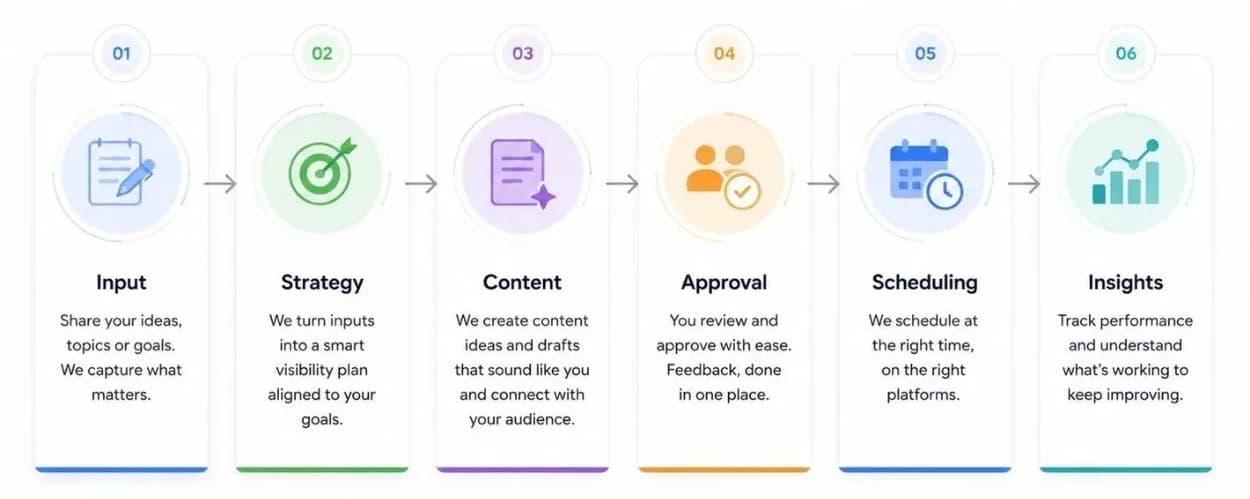
Most businesses do not fail on social media because they are bad at content.
They fail because they treat social media like a daily task instead of a business system.
One week they post every day. Then client work gets busy. Then they disappear. Then they return with a festive post, a random product update, or a quote graphic.
That is not consistency.
That is noise.
To stay consistent on social media for business, you need a repeatable system for planning, creating, scheduling, and reviewing your content. Not more pressure. Not more random ideas. Not another folder full of unused templates.
You need a simple visibility system.
Quick Answer: How Do You Stay Consistent on Social Media for Business?
To stay consistent on social media for business, define your content pillars, create a weekly content calendar, batch-create posts, schedule content in advance, repurpose existing ideas, and track what is working. Consistency becomes easier when social media is managed as a visibility system instead of a daily creative burden.
Before you post more, check where your business currently stands.
Check your Visibility Score and understand what needs improvement in your online presence.
Why Businesses Struggle to Stay Consistent on Social Media
Most business owners already know they should be active online.
They know customers check Instagram, LinkedIn, Facebook, Google, YouTube, and other platforms before making decisions. They know competitors are posting. They know online visibility matters.
The problem is not awareness.
The problem is execution.
Most businesses struggle with social media consistency because:
They do not know what to post.
They wait for inspiration.
They create content at the last minute.
They depend on one person to do everything.
They do not have a content calendar.
They do not repurpose existing content.
They do not review what is working.
They post only when there is a festival, launch, offer, or urgent sales need.
They treat social media as optional until leads slow down.
That last one is the killer.
If your business only shows up online when you need sales, your audience can feel it. The content becomes reactive, promotional, and inconsistent.
Social media consistency does not come from motivation. Motivation is unreliable. Some days you will have ideas. Some days you will not. Some weeks your team will be free. Some weeks client work, operations, hiring, sales, and follow-ups will take over.
That is why your business needs a system.
Google also recommends creating helpful, reliable, people-first content instead of content made only to manipulate search engines. The same principle applies to social media. Do not post just because “the algorithm needs content.” Post because your audience needs clarity, proof, education, reminders, and reasons to trust you. You can read Google’s guidance on people-first content here: Creating helpful, reliable, people-first content.
Why Social Media Consistency Matters for Business Visibility
Social media consistency matters because people rarely trust a business after seeing it once.
They need repeated exposure.
They need to see what you do, who you help, what you believe, how you work, and why they should trust you. One post will not do that. One campaign will not do that. One viral reel will not do that.
Consistency helps your business:
Stay visible to existing and potential customers.
Build familiarity over time.
Educate people before they speak to you.
Create trust before the sales call.
Show proof of work.
Build founder or brand authority.
Stay active in the mind of your audience.
Create a library of useful content.
Support discovery across social platforms and search engines.
This is especially important because social media is no longer just a place for entertainment. People use platforms to discover businesses, compare options, check credibility, and decide whether a brand feels trustworthy.
According to Sprout Social’s 2026 Content Strategy Report, brand content still has a major role in consumer interaction and trust-building. You can explore the report here: The 2026 Social Media Content Strategy Report.
But here is the honest part.
Consistency does not mean posting random content every day.
That is just activity.
Consistency means showing up with a clear message, useful ideas, and a repeatable rhythm.
Visibility compounds. Random posting does not.
What Does Consistency on Social Media Actually Mean?
Social media consistency does not mean posting every day.
It means your business has a predictable rhythm of showing up with relevant content.
A small business posting three useful posts every week for six months will usually build stronger visibility than a business posting twenty times in one week and then disappearing for a month.
Consistency means:
Your audience sees you regularly.
Your messaging does not keep changing randomly.
Your content supports clear business goals.
Your posts are connected to repeatable themes.
Your brand has a recognizable voice.
Your team knows what needs to be created.
Your content is reviewed and improved over time.
The best way to think about consistency is this:
Consistency is not about volume. It is about rhythm, relevance, and repeatability.
If your business can only manage three strong posts per week, start there.
Three posts per week with a proper system is better than daily posting that burns out after ten days.
Step 1: Define Your Business Visibility Goal
Before asking “What should I post?”, ask a better question:
Why are we posting?
Different businesses need different visibility goals.
Your goal may be:
Brand awareness
Lead generation
Founder visibility
Product education
Local discovery
Trust building
Community building
Hiring visibility
Partnership visibility
Customer retention
Event promotion
Thought leadership
For example, a local restaurant may want more people nearby to discover offers, dishes, events, and customer reviews.
A consultant may want to build authority and generate inbound leads.
A founder may want to become known for a specific problem, category, or point of view.
A B2B company may want to educate potential buyers before they book a call.
Without a goal, your content becomes random.
You post a quote on Monday, a festival post on Tuesday, a product image on Wednesday, and a reel copied from a competitor on Friday.
That may look active, but it is not strategic.
Ask these questions before creating your content plan:
What do we want people to remember us for?
Who should see our content?
Which platform matters most for our audience?
What action should people take after seeing our content?
What problems do our customers repeatedly ask about?
What proof can we show?
What topics do we want to own in our category?
Once your visibility goal is clear, content planning becomes much easier.
If your goal is founder visibility, you may want to explore Founder Visibility.
If your goal is to understand your current online presence first, start with the Visibility Score.
Step 2: Create 3 to 5 Content Pillars
Content pillars are recurring themes your business uses to create content consistently.
They help you avoid the most common content problem:
“What should we post today?”
Instead of starting from a blank page every time, you return to a few repeatable themes.
For most businesses, these five content pillars work well:
Educational content
Problem-solution content
Proof and case studies
Founder or behind-the-scenes content
Offer or product/service content
Let’s break them down.
1. Educational Content
This helps your audience understand something useful.
Examples:
“How to choose the right digital marketing agency”
“What to check before hiring a website developer”
“How to improve your Google Business Profile”
“Why your ads are getting clicks but no leads”
Educational content builds trust because it helps people before they buy.
2. Problem-Solution Content
This speaks directly to a pain point your audience already has.
Examples:
“Posting daily but still not getting leads?”
“Why your Instagram page looks active but does not convert”
“The reason your business content feels random”
“Why your founder posts are not building authority”
Problem-solution content works because it makes the reader feel seen.
3. Proof and Case Studies
This shows that your business can actually deliver.
Examples:
Client results
Testimonials
Before-after examples
Screenshots
Customer stories
Project breakdowns
Lessons from real work
People do not just want claims. They want evidence.
4. Founder or Behind-the-Scenes Content
This makes the business more human.
Examples:
Founder opinions
Lessons learned
Team moments
Work process
Business decisions
Mistakes and learnings
Personal stories connected to business values
Founder-led content is powerful because people trust people before they trust logos.
5. Offer or Product/Service Content
This explains what you sell and why it matters.
Examples:
Service explainers
Product benefits
Use cases
Pricing reminders
Demo invitations
Limited-time offers
“Who this is for” posts
This pillar is important, but it should not be the only thing you post.
If your business only posts offers, people will tune out.
Example Content Pillars for a Digital Marketing Agency
A digital marketing agency could use:
Social media tips
Paid ads mistakes
Client results
Founder opinions
Service explainers
Example Content Pillars for a Food Brand
A food brand could use:
Ingredients
Recipes
Customer stories
Quality process
Product education
Example Content Pillars for a Consultant
A consultant could use:
Industry insights
Client problems
Frameworks
Case examples
Founder point of view
The goal is not to create unlimited ideas.
The goal is to create a simple idea engine.
If you want help turning your business inputs into content pillars and post ideas, Digibility’s visibility system can help you plan content around your business goals instead of posting randomly.
Explore Digibility’s Smart Calendar.
Step 3: Build a Simple Social Media Content Calendar
A social media content calendar helps your business decide what to post, when to post, where to post, and why.
It does not need to be complicated.
In fact, most businesses fail with content calendars because they overcomplicate them.
They create a huge spreadsheet with too many columns, too many platforms, too many content types, and too many approvals. Then nobody uses it.
Start simple.
A basic weekly content calendar can look like this:
Day | Content Type | Purpose |
Monday | Educational post Teach | something useful |
Tuesday | Founder insight | Build trust and authority |
Wednesday | Problem-solution post | Speak to a customer pain point |
Thursday | Proof, testimonial, or case study | Show credibility |
Friday | Offer or CTA post | Move people toward action |
This structure works because it gives your business a rhythm.
You are not asking, “What should we post today?”
You already know the role of the post.
Now you only need to choose the topic.
A Simple Monthly Planning Method
At the start of every month, choose:
3 to 5 content pillars
4 weekly themes
12 to 20 post ideas
1 primary CTA
1 business goal
1 key offer or campaign
1 metric to review
For example:
Business goal: Generate leads for website audits Primary CTA: Check your Visibility Score Weekly theme 1: Online visibility mistakes Weekly theme 2: Content consistency Weekly theme 3: Founder visibility Weekly theme 4: Social media performance
This keeps content connected to business outcomes.
Meta Business Suite also allows businesses to create and schedule posts for Facebook and Instagram. You can read Meta’s official scheduling guidance here: Create and schedule posts in Meta Business Suite.
Instagram’s official business learning resources also recommend planning content around clear business goals and consistent publishing. You can explore that here: Instagram content planning for business.
But remember: tools do not fix a broken strategy.
A scheduling tool helps only after you know what to say.
Step 4: Batch-Create Your Content
If you try to create content every day, you will eventually stop.
That is normal.
Most business owners and small teams do not have the time or mental energy to think of fresh content every morning.
That is why batching works.
Batching means creating multiple pieces of content in one planned session.
Instead of writing one post every day, block one or two content creation sessions per week.
For example, one 60-minute content session can produce:
2 educational posts
1 founder insight
1 customer proof post
1 offer post
That gives you a full week of content.
What to Batch Together
You can batch:
Caption writing
Reel scripts
Carousel ideas
Design briefs
Testimonials
Founder notes
Blog-to-social repurposing
Short videos
Offer posts
FAQs
Batching works because it removes daily decision-making.
The goal is not to be creative every day.
The goal is to build a repeatable content production routine.
A Simple Weekly Batch Workflow
Use this structure:
Monday: Decide topics for the week Tuesday: Write captions and scripts Wednesday: Create visuals or record videos Thursday: Review and schedule Friday: Engage, reply, and track
This is manageable.
And manageable beats ambitious.
Step 5: Schedule Posts in Advance
Scheduling protects consistency.
It makes sure your content goes live even when you are busy with clients, operations, sales, hiring, or travel.
If your content depends on someone remembering to post manually every day, gaps will happen.
Scheduling helps you:
Avoid last-minute posting
Review content before publishing
Keep your brand active during busy weeks
Plan campaigns in advance
Maintain a steady rhythm
Reduce stress for the team
A good rule for small businesses is:
Plan weekly. Schedule weekly. Review monthly.
Do not try to build a six-month content calendar on day one.
That usually becomes stale.
Start with one week.
Then two weeks.
Then one month.
Once your process is stable, increase the planning window.
Digibility’s Smart Calendar is designed to help businesses plan and manage content activity more systematically, so the business is not starting from scratch every week.
Step 6: Repurpose Content Instead of Starting From Scratch
One of the biggest reasons businesses become inconsistent is that they believe every post needs a brandnew idea.
That is false.
Smart businesses repurpose.
Repurposing means turning one idea into multiple formats for different platforms.
For example, one blog can become:
A LinkedIn post
An Instagram carousel
A short reel script
A newsletter
A YouTube Short
A Google Business Profile update
A FAQ answer
A sales follow-up message
A website resource
One customer question can become:
A social post
A blog section
A reel
A carousel
A sales script
A support article
One founder opinion can become:
A LinkedIn post
A quote card
A short video
A newsletter opener
A discussion post in a community
Here is a simple example.
A blog titled “How to choose the right digital marketing agency” can become:
LinkedIn post: “5 questions to ask before hiring an agency”
Instagram carousel: “Red flags when choosing a marketing agency”
Reel script: “Do not hire an agency before checking this”
Newsletter: “How to avoid wasting money on marketing retainers”
FAQ: “How do I know if an agency is right for my business?”
That is how consistency becomes easier.
You stop creating from zero.
You start building from existing ideas.
If your business already has blogs, website pages, customer questions, founder thoughts, sales objections, reviews, or case studies, you already have content raw material.
You just need a system to turn it into useful posts.
Digibility’s content creation and visibility workflows can help convert business inputs into platform-ready content. You can explore one of the content creation features here: Reel Generator.
Step 7: Track What Is Working
Consistency is not just posting regularly.
Consistency is learning regularly.
If you do not track performance, social media becomes activity.
If you track performance, social media becomes a growth system.
You do not need to track every metric under the sun. Start with the metrics that connect to your goal.
Metrics to Track
Track:
Reach
Engagement
Saves
Shares
Comments
Profile visits
Website clicks
Leads
Direct messages
Follower growth
Content formats that perform better
Topics that attract the right audience
Posts that create conversations
Posts that lead to enquiries
What to Review Every Month
At the end of each month, ask:
Which posts got the most reach?
Which posts got the right kind of engagement?
Which topics attracted potential customers?
Which posts led to profile visits or website clicks?
Which formats were easiest to produce?
Which posts should we repurpose?
Which content pillars need improvement?
Did our visibility improve?
This is where most businesses miss the plot.
They post content, but they do not learn from it.
Then they repeat the same mistakes every month.
Digibility’s ROI and reporting feature can help businesses understand whether their visibility activity is moving in the right direction.
The goal is not to chase vanity metrics.
The goal is to understand what is helping your business become more visible, trusted, and discoverable.
Common Mistakes That Break Social Media Consistency
If your business is struggling to stay consistent, check if you are making any of these mistakes.
Mistake 1: Trying to Post Every Day Without a Plan
Daily posting sounds good until the third week.
If your team does not have a content calendar, content pillars, templates, and a review system, daily posting becomes chaos.
Start with a rhythm you can sustain.
Three good posts per week are better than thirty rushed posts followed by silence.
Mistake 2: Copying Competitors Blindly
Competitor research is useful.
Competitor copying is lazy.
Your competitors may have a different audience, offer, team size, budget, brand voice, or business goal.
Use competitors for inspiration, not direction.
Mistake 3: Posting Only Offers
If every post is “buy now,” “book now,” “limited offer,” or “DM us,” people will stop paying attention.
Your content should educate, build trust, show proof, answer questions, and then sell.
Selling is important.
But if you only sell, you become easy to ignore.
Mistake 4: Depending Only on Trending Content
Trends can help reach.
But trends are not a strategy.
If your entire content plan depends on trending audio, memes, or viral formats, your brand will look active but not necessarily useful.
Use trends only when they support your message.
Mistake 5: Ignoring Founder-Led Content
For many businesses, especially service businesses, founder-led content builds trust faster than polished brand posts.
People want to know who is behind the business.
They want opinions, stories, lessons, mistakes, values, and proof of thinking.
If you are a founder, do not hide behind generic brand content.
Mistake 6: Creating Everything From Scratch
This is exhausting.
Your business already has content material:
Sales calls
Customer questions
Reviews
Case studies
Blogs
Emails
Internal notes
Product demos
Team conversations
Common objections
Use it.
Mistake 7: Not Scheduling in Advance
Manual posting works for a few days.
Then life happens.
Scheduling keeps the system running.
Mistake 8: Not Reviewing Performance
If you do not review, you are guessing.
Your audience is already telling you what they care about through clicks, comments, saves, shares, replies, and enquiries.
Pay attention.
Mistake 9: Treating Social Media as a Side Task
This one is blunt, but true.
If social media is always treated as “something we will do when we get time,” your business will never stay consistent.
Visibility needs ownership.
Someone must be responsible for planning, creation, publishing, engagement, and review.
Even if that person uses AI or automation, ownership still matters
A Simple 30-Day Social Media Consistency Plan for Businesses
If your business has been inconsistent, do not try to fix everything at once.
Use this 30-day plan.
Week 1: Set the Foundation
Choose your primary platform.
Define your visibility goal.
Select 3 to 5 content pillars.
List 20 common customer questions.
Decide your primary CTA.
Example CTA:
Week 2: Build the Calendar
Create a weekly posting rhythm.
Assign one content type to each posting day.
Write 8 to 12 post ideas.
Choose 2 proof-based posts.
Choose 2 educational posts.
Choose 2 founder-led posts.
Week 3: Batch and Schedule
Write captions.
Create visuals.
Record videos if needed.
Review content.
Schedule posts in advance.
Use your scheduling tool, Meta Business Suite, LinkedIn scheduler, or a visibility management system like Digibility.
Week 4: Review and Improve
Check reach and engagement.
Identify top-performing topics.
Note which posts brought profile visits or clicks.
Repurpose the best post.
Plan the next month based on learning.
This is how consistency becomes practical.
Not motivational.
Practical.
How AI Can Help You Stay Consistent on Social Media
AI can help businesses stay consistent, but only if used properly.
AI should not replace your thinking.
It should reduce the blank-page problem.
AI can help with:
Content ideas
Caption drafts
Reel scripts
Content calendars
Repurposing blogs into posts
Turning FAQs into social content
Creating variations for different platforms
Maintaining tone and structure
Reviewing content gaps
Suggesting new post angles
But AI also has limits.
If you give AI weak inputs, you will get generic content.
If your prompts are vague, your posts will sound like everyone else.
The better approach is to give AI:
Your business information
Your audience
Your offer
Your content pillars
Your brand voice
Your customer questions
Your proof points
Your visibility goal
That is when AI becomes useful.
This is also why Digibility is positioned as more than an AI caption tool.
Digibility is built as an AI-powered visibility management system that helps businesses plan, create, schedule, and track their visibility more consistently.
The difference matters.
Caption tools help you write.
Visibility systems help you show up with purpose.
How Digibility Helps Businesses Stay Consistent on Social Media
Your business does not need more random posts.
It needs a repeatable visibility system.
Digibility helps businesses stay consistently visible online by supporting the full visibility process:
Analyze your current online visibility
Understand where your brand stands
Plan content around business goals
Create content ideas and posts
Build a smart content calendar
Schedule content
Track consistency and performance
Improve based on visibility insights
Digibility is not just another tool for writing captions.
It helps businesses manage the full visibility process from planning to execution to reporting.
That matters because consistency is not a content problem alone.
It is a system problem.
If you want to start with the simplest step, check where your business visibility stands today.

Written by